06 Feb 1931

City Lights
A tramp falls in love with a beautiful blind flower girl. His on-and-off friendship with a wealthy man allows him to be the girl's benefactor and suitor.

The young ice skating talent, Liesl, lands a part in a new Revue at the Palast Theatre simply because she is confused with someone else. In reality, the roll was to be awarded to Lu Panther, the untalented girlfriend of the theatre's owner, Wildner. After a series of accidents and little disasters, Wildner shuts down the theatre before the Revue can take place. But the Revue's director, Ernst Eder, decides shortly thereafter to present the Revue on an ice skating rink belonging to Liesl's uncle. After a successful run, at first at the Wiener Prater, the performers move on to Spain, Hungary, and a night club with a Jazz orchestra. The Revue becomes a huge success ... and, of course, Ernst and Liesl end up together, too.

Liesl Strolz

Ernst Eder

Meister Strolz

Josef Wildner

Toni

Lu Panther

Direktor Schmoller

Scherzinger
Onkel Strolz (scenes deleted)
Franz
Gertie Kramer

Poldi
Bächlein
Frau Wulitsch
Kugler - Theaterinspizient

06 Feb 1931

A tramp falls in love with a beautiful blind flower girl. His on-and-off friendship with a wealthy man allows him to be the girl's benefactor and suitor.

20 Dec 1940

A musician is offered a job in Vienna as stage director, but his disagreements with the aristocratic opera manager end in abrupt firing in spite of a mutual attraction. He's quickly engaged by another theatre and becomes famous for his lavish stage productions and fine acting, which begins their golden age with Suppé and Strauss.

03 May 1944

A musical film based on biographical facts about Clara Wieck's love for composer Robert Schumann (1810-1856), her marriage against her will, Schumann's triumph, and his tragic end due to mental illness. The film is beautiful and entertaining, full of noble spirit and beautiful words about art and love, which only conflict in a theoretical context; not least thanks to its solid cast, this film is quite serious and far from kitsch. Completed in 1944, during World War II, the film was rejected by the Nazi leadership, but was eventually released and enjoyed success with an audience already weary of war.

27 May 1932

He was known as Anatole Litvak during his Hollywood directorial career, but he was still Anatole Litwak when he helmed the German musical Das Lied Einer Nacht (The Song of Night). Famed Polish tenor Jan Kiepura stars as famed Italian tenor Ferraro. Escaping from his tyrannical manager, Ferraro switches identities with a young tourist (Fritz Schulz) and goes off on an unscheduled Swiss holiday. Still travelling incognito, our hero falls in love with a winsome mountain girl (Magda Schneider). Alas, both his romance -- and his freedom -- are placed in jeopardy when it turns out that the charming young fellow with whom Ferraro traded identities was actually a notorious swindler. Anatole Litvak also directed the English-language version of Das Lied Einer Nacht, Be Mine Tonight

27 Feb 1953

Ramesh, the youngest son of a well-to-do family, falls in love with a woman he hears singing on the radio -- even though he's never seen her. When he finds out his mystery woman is Ksama, a servant in his parents' house, everything is thrown into turmoil. Will Ramesh accept Ksama? Will they get married? Love may just conquer all in this classic Bollywood melodrama.

19 Aug 1954

On the Spring of 1945 the Jackson circus is heading towards the border with the clown Peti and Aida, the elephant. They have to play for the Hungarian Fascists, while Peti is hiding the Jew Annuska and Sanyika.

04 May 1954

Celebrating the end of World War II and liberation of their city, a group of students is set on holding a cultural evening. They invite Ema, a reclusive piano teacher from the same building, to play for them. Ema declines, but starts reminscing back on her own life and the historical events that have seemingly overshadowed it.

03 Mar 1944

Without his brother's knowledge, Joseph Schrammel popularizes his songs in Vienna. When Johann learns of this, a dispute breaks out between the siblings and their two fellow musicians, which can only be resolved with the help of the singer Fiakermilli. The reconciled quartet then performs under the name "Die Schrammeln" and becomes famous. But another dispute is already looming.

20 Aug 1952

We have linguists, we have literary men, we have newspapers, actors, musicians, but we have no national opera!", lamented the champions of national revival in the middle of the last century. Hungarian music culture at home is limited to the performance of works by foreign composers. And the public demands Hungarian opera, and such a challenge is not easy to meet. So let's see who is up to the task!

23 Aug 1939

Johann Strauss firmly established himself as the leader of a dance orchestra in Vienna in the 1840s. His sons Johann junior and Josef have clearly inherited their father's talent. Nevertheless, father Johann is strictly opposed to both of them training as composers.

20 Sep 1955

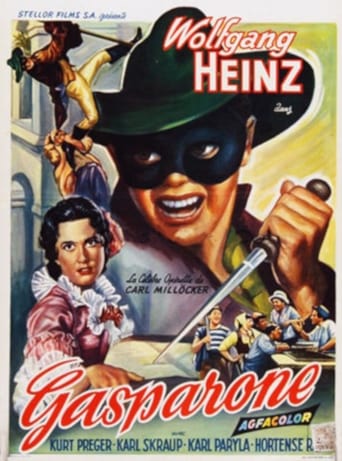
Based on the operetta of the same name by Carl Milöcker. The residents of an Austrian town decide to teach their eccentric mayor a lesson. A young fisherman dresses up as the famous bandit Gaspare and goes to see the mayor. The mayor, terrified, flees from "Gaspare" and commits a series of ridiculous acts, becoming the laughing stock of the whole town.

30 Jan 1938

Set in North Karelia, whne Antti Ihalainen's house runs out of matches, he goes to borrow some from a neighbor. On the road, he meets a rich widower, Jussi Vatanen, who asks Ihalai to be his speaker and friend on an engagement trip to the city of Jo. The hosts from Lieper are snorting drunkenly from behind their shoulders.

09 Apr 1936

Longfellow Deeds lives in a small town, leading a small town kind of life. When a relative dies and leaves Deeds a fortune, Longfellow moves to the big city where he becomes an instant target for everyone. Deeds outwits them all until Babe Bennett comes along. When small-town boy meets big-city girl anything can, and does, happen.

25 Oct 1940

The young opera singer Carla is in love with the talented young composer Michele, who wants to make it big with classical music and writes his first opera, "The Return of Odysseus," for Carla. But Carla is more successful than he is and gets a gig at La Scala in Milan. Through her connections, she manages to find a publisher for Michele's opera. But when Michele learns what the publisher really thinks of his work, he leaves and abandons Carla. A year later, Carla finds Michele again. He has since become a sought-after composer, but is embittered because he is only successful with pop songs. His new revue "Dream Music," a reworking of his opera, is about to premiere. Carla then arranges for Michele's original opera to premiere in Budapest with her in the lead role.

16 Apr 1935

Sándor Barinkay joins the gypsies en route to his home village hiding his real identity as an Hungarian nobleman, whose parents were sent to exile. He claims his former properties, now taken by a pig merchant who plays the fool to the villagers' delight. Yet this man has an interesting daughter, and there's also the beautiful gypsy Saffi to consider. And a family hidden treasure to be found.

05 Nov 1948

The story of Finnish singer Abraham 'Aappo' Ojanperä, who was born in the late 1850s. On his journey from a crier boy from Liminga to an international singing star, Aappo never forgets his first love Katri, who faithfully waits in Liminga for his return.

06 Jun 1985

This time the "amici" (friends) are just four: Necchi, Meandri, Mascetti and Sassaroli. Nevertheless they are older they still love to spend their time mainly organizing irresistible jokes to everyone in every kind of situation. Mascetti is hospitalized in a geriatric clinic. Of course the place become immediately the main stage for all their jokes. After some jokes they decided to place an ultimate incredible and farcical joke to the clinic guests.

12 Aug 1955

Marci is drafted from a typical block building in the 6th district in Pest. He says good-bye to Juli living in the same house, with whom they are both very much fond of each other, but neither of them makes a confession. Juli works in a factory, and with her friend Gizus she goes out in the evening for dancing and drinking. After a year, Marci comes back for holiday, he is full of love.

01 Jan 1943

A marching band of Germans, Italians, and Japanese march through the streets of swastika-motif Nutziland, serenading "Der Fuehrer's Face." Donald Duck, not living in the region by choice, struggles to make do with disgusting Nazi food rations and then with his day of toil at a Nazi artillery factory. After a nervous breakdown, Donald awakens to find that his experience was in fact a nightmare.

31 Aug 1951

Diederich Heßling is scared of everything and everyone. But as he grows up, he comes to realize that he has to offer his services to the powers-that-be if he wants to wield power himself. His life motto now runs: bow to those at the top and tread on those below. In this way, he always succeeds: as a student in a duel-fighting student fraternity and as a businessman in a paper factory. He cajoles the obese district administrative president Von Wulkow and wins his favor. He slanders his financial rivals and hatches a plot with the social democrats in the town council. On his honeymoon with his rich wife Guste, he finally finds a chance to do his beloved Kaiser a favor. And when a memorial to the Kaiser is unveiled in the town where Diederich lives and works, he delivers the address. He stands behind the lectern in the pouring rain, saluting his Kaiser. The crowd is dispersed. Everything is laid in ruins...